
Thucydides Returns
The ancient logic behind the emergent U.S.-China rivalry

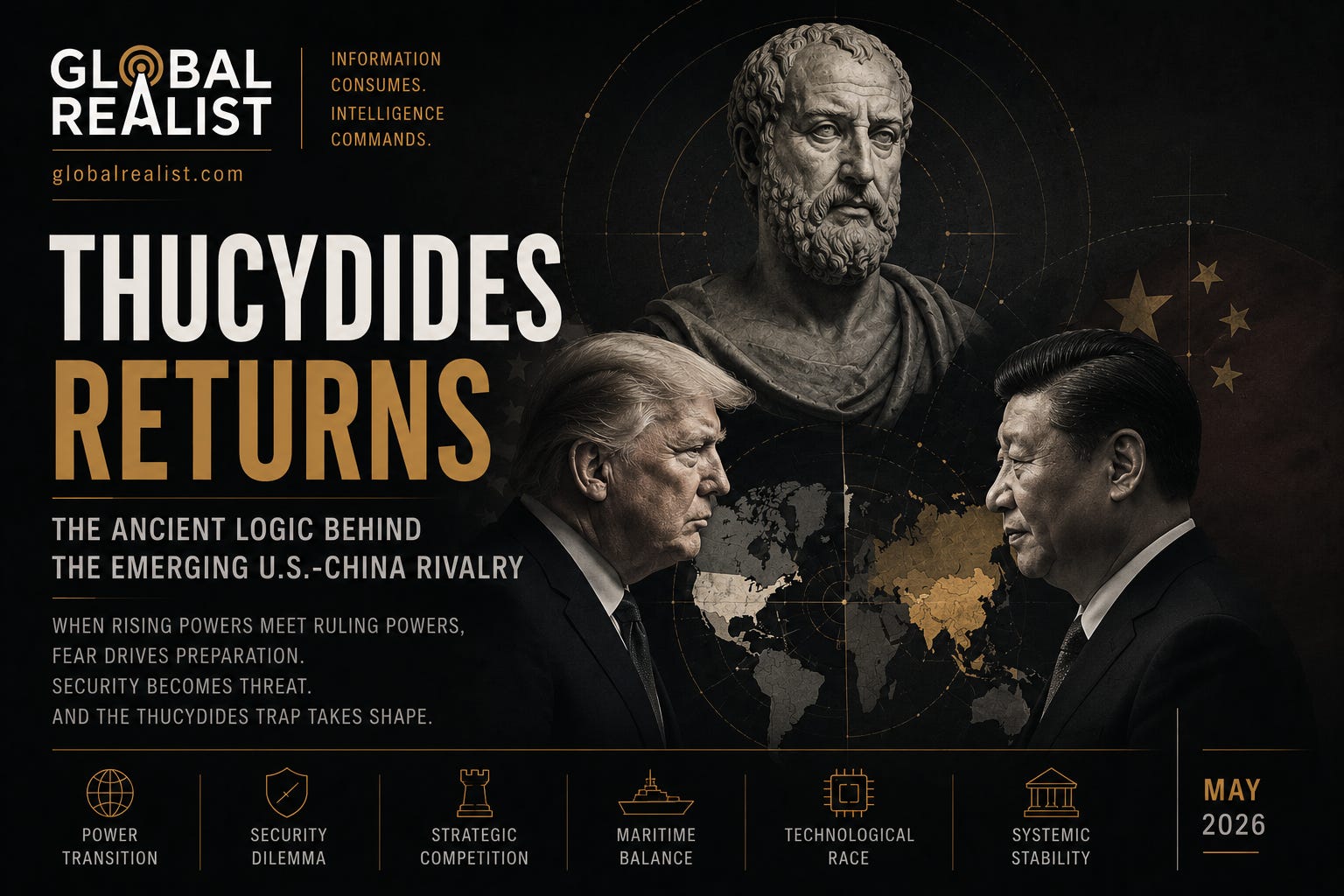
What Xi Said in Beijing
In his opening remarks at the Great Hall of the People on May 14, 2026, Xi Jinping posed a question to the world rather than to Donald Trump alone. “History, the world, and the people are watching whether the two countries can transcend the so-called ‘Thucydides Trap’ and forge a new model for relations between major powers.”
At the banquet that evening, Xi extended the framing: “Achieving the great rejuvenation of the Chinese nation and making America great again can totally go hand in hand, and advance the wellbeing of the whole world.”
The phrase did not appear by accident. Beijing has deployed the Thucydides Trap as a doctrinal instrument across multiple high-level encounters. Chinese Ambassador Xie Feng raised it in dialogue with Graham Allison at Harvard in April 2024. Xi raised it with President Biden at the APEC summit in Lima in November 2024, with the same formulation: not a historical inevitability. Xi told a U.S. Senate delegation led by Chuck Schumer in October 2023 that the trap is not inevitable, and Planet Earth is vast enough to accommodate the respective development and common prosperity of China and the US.
The repetition matters. Beijing has converged on the Thucydides Trap as the rhetorical container through which it presents its preferred framing of the U.S.-China relationship to American audiences. Understanding what the doctrine actually says, and what realism makes of it, is therefore a prerequisite for reading Chinese statecraft at the level it now operates.
The Source Text and the Modern Thesis
The concept originates in Thucydides’ History of the Peloponnesian War, the foundational text of the Western realist tradition. Thucydides was an Athenian general writing in the late fifth century BCE, attempting to explain the long war between Athens and Sparta that had consumed the Greek world for a generation. His central explanatory line, in the translation most commonly cited, reads: “It was the rise of Athens, and the fear that rise engendered in Sparta, that made war inevitable.”
The line is the seed of structural realism. It locates the cause of war not in the personalities of the leaders, not in ideology, not in misunderstanding, but in the geometry of the system itself. A rising power accumulates capability. An established power perceives the accumulation as a threat. The interaction of those two facts under conditions of anarchy — no overarching authority to enforce restraint — produces a competition that the leaders themselves cannot fully control. The system selects for the outcome.
Graham Allison, a political scientist at Harvard’s Belfer Center, adopted Thucydides’ line as the title for an empirical research program in the early 2010s. Allison and his collaborators surveyed five centuries of great-power transitions and identified sixteen cases in which a rising power had threatened to displace an established one. In twelve of those sixteen cases, the result was war. Allison published the analysis in his 2017 book Destined for War: Can America and China Escape Thucydides’s Trap?
Allison’s argument is calibrated. He does not claim that war is inevitable. He claims that the base rate is high, that the structural pressure is real, and that escaping it requires deliberate statecraft that runs against the gravity of the system. His thesis became the standard reference point for U.S.-China analysis across academic, policy, and intelligence circles. It is the analytical frame within which both Washington and Beijing now conduct much of their public reasoning about the bilateral relationship.
How the Three Realist Schools Read the Trap
The Thucydides Trap is structural realism’s signature claim, but the realist family contains several schools, and each reads the proposition differently.
Classical realism, in the tradition of Thucydides himself, Machiavelli, Hobbes, and the twentieth-century theorists Hans Morgenthau and Reinhold Niebuhr, treats power competition as rooted in human nature. States behave as they do because the human beings who run them are driven by ambition, fear, honor, and the will to dominate. Under classical realism, structural pressure is real, but the outcome of a power transition depends substantially on the wisdom or recklessness of the statesmen who manage it. War between rising and incumbent powers is frequent but not mechanical. Skilled statecraft can avert it. Reckless statecraft can accelerate it. Leaders matter.
Structural defensive realism, most clearly articulated by Kenneth Waltz and developed by scholars including Stephen Walt and Charles Glaser, treats states as security maximizers operating in an anarchic system. States accumulate power only to the extent required to ensure survival. Excessive accumulation triggers balancing coalitions that leave the over-accumulator worse off than it began. Under defensive realism, the Thucydides Trap is real but escapable: rising powers that calibrate their accumulation to defensive requirements can avoid triggering the war that fear-driven escalation would produce. Restraint is rational. Hegemonic overreach is self-defeating. The transition can be managed.
Structural offensive realism, associated with John Mearsheimer, takes the harder view. States are power maximizers, not security maximizers. The anarchic system forces every major power to seek as much relative power as it can sustain, because any unaccumulated power is power available to a rival. Under offensive realism, the Thucydides Trap is not merely a base rate. It is the predictable output of the system’s underlying logic. Rising powers cannot stop rising because the system rewards rising. Established powers cannot stop responding because the system penalizes failing to respond. Both parties may sincerely wish to avoid war and still arrive at it, because the structural pressure operates independently of their preferences. Mearsheimer has applied this framework directly to the U.S.-China case and concludes that the probability of conflict is high, regardless of whether either leadership desires the outcome.
A reader who wants the more granular distinction between these schools can refer to the Global Realist pieces on classical versus structural realism and offensive versus defensive realism in the archive. The point for present purposes is that all three schools treat the structural pressure as real. They differ on whether the pressure is escapable, on what makes it escapable, and on how much weight to assign to leader perception relative to system geometry.
Xi’s Instrumental Deployment
Xi’s use of the Thucydides Trap is doctrinally specific, and it does not map cleanly onto any of the three realist schools. The instrument is calibrated to do work that none of the schools would endorse on its own terms.
Xi invokes the structural-realist warning. He acknowledges that the rise of China and the established position of the United States produce a system-level pressure that points toward conflict. This is the framing that legitimates Beijing’s position as a great-power equal to Washington rather than a regional contender. It places China inside the analytical frame that American strategic culture takes seriously.
Xi then denies the structural-realist conclusion. The trap is not inevitable. War can be averted. The pressure can be transcended. This is the move that classical realism would recognize and that defensive realism would conditionally accept, but only if accompanied by demonstrated calibration in the rising power’s accumulation. Xi does not offer that calibration. He offers instead the proposition that correct perception — correct strategic perception, in his Lima formulation — can override the geometry.
Xi then transfers the responsibility for escape. The framing positions the established power as the party whose choices determine whether war occurs. The rising power, in Xi’s deployment, is a constant. China rises. The question is whether the United States manages its response correctly. This is the inversion that an offensive realist would reject categorically, because it asks the incumbent to bear the full burden of avoidance while the rising power continues to accumulate. It is also the inversion that classical realism would treat with skepticism, because it strips the rising power of the responsibility that any realist tradition assigns to all major powers in a transition.
The Chinese diplomatic record is consistent on the point. Xie Feng at Harvard: “Why should we still jump headlong into it?” — addressed to Washington. Xi at Lima: “It is important to have a correct strategic perception” — addressed to the United States. Xi in Beijing: “whether the two countries can transcend” — phrased as a joint question but coupled with the Taiwan warning that defines the perimeter inside which the joint question can be asked. The doctrinal structure is durable. Beijing invokes the realist warning, denies the realist conclusion, and assigns the burden of escape to the party that is being asked to accommodate the rising power’s continued accumulation.
The EIR Counter-Reading
Existential Imperative Realism offers a different reading of the Thucydides geometry, one that the standard three schools do not fully capture.
EIR treats the rising-versus-incumbent framing as analytically insufficient when applied to the U.S.-China case. The competition is not a contest between an ascending challenger and a declining incumbent in the classical sense. It is a contest between two civilizational-scale states, each pursuing distinct survival imperatives under structural pressure, each consolidating its civilizational core in response to perceived existential threats from the other. The geometry is not a transition. It is a parallel hardening. Both states are accumulating. Both states are reorganizing internal structures around survival logic rather than around the integration premises of the prior cycle.
Under EIR, the question of whether the trap is escapable is therefore poorly framed. The relevant question is whether the structural competition can be managed at a level below open kinetic conflict. The answer, as the Beijing summit suggests, is conditional. The competition can be managed when the cost of rupture exceeds the cost of continued competition for both parties. The competition cannot be managed when the survival imperatives of either party require movement at a tempo that the other cannot tolerate.
This is the framework within which the Taiwan question, the semiconductor hostage geometry, the rare-earth coercion architecture, the AI compute frontier, and the maritime chokepoint contest all operate. Each is a pressure variable inside the managed-rivalry equilibrium. Each can be re-priced as the underlying conditions move. None resolves the structural competition, because the structural competition is the operating mode rather than the problem to be solved.
Xi’s invocation of the Thucydides Trap, read under EIR, is best understood as an instrument inside the managed-rivalry architecture rather than as an attempt to escape it. The invocation positions Beijing as the party offering accommodation while continuing the accumulation that the accommodation is meant to legitimize. The invocation places the burden of restraint on Washington while preserving Beijing’s freedom of maneuver on Taiwan, the South China Sea, the technology indigenization curve, the Belt and Road infrastructure architecture, and the Eurasian consolidation track. The invocation, in short, is statecraft rather than analysis.
What the Doctrine Tells Us
The Thucydides Trap is a useful analytical concept. It identifies a real pattern in the historical record. It captures the structural pressure that operates on great-power transitions. It frames the U.S.-China relationship in terms that both parties recognize and that both parties find operationally useful.
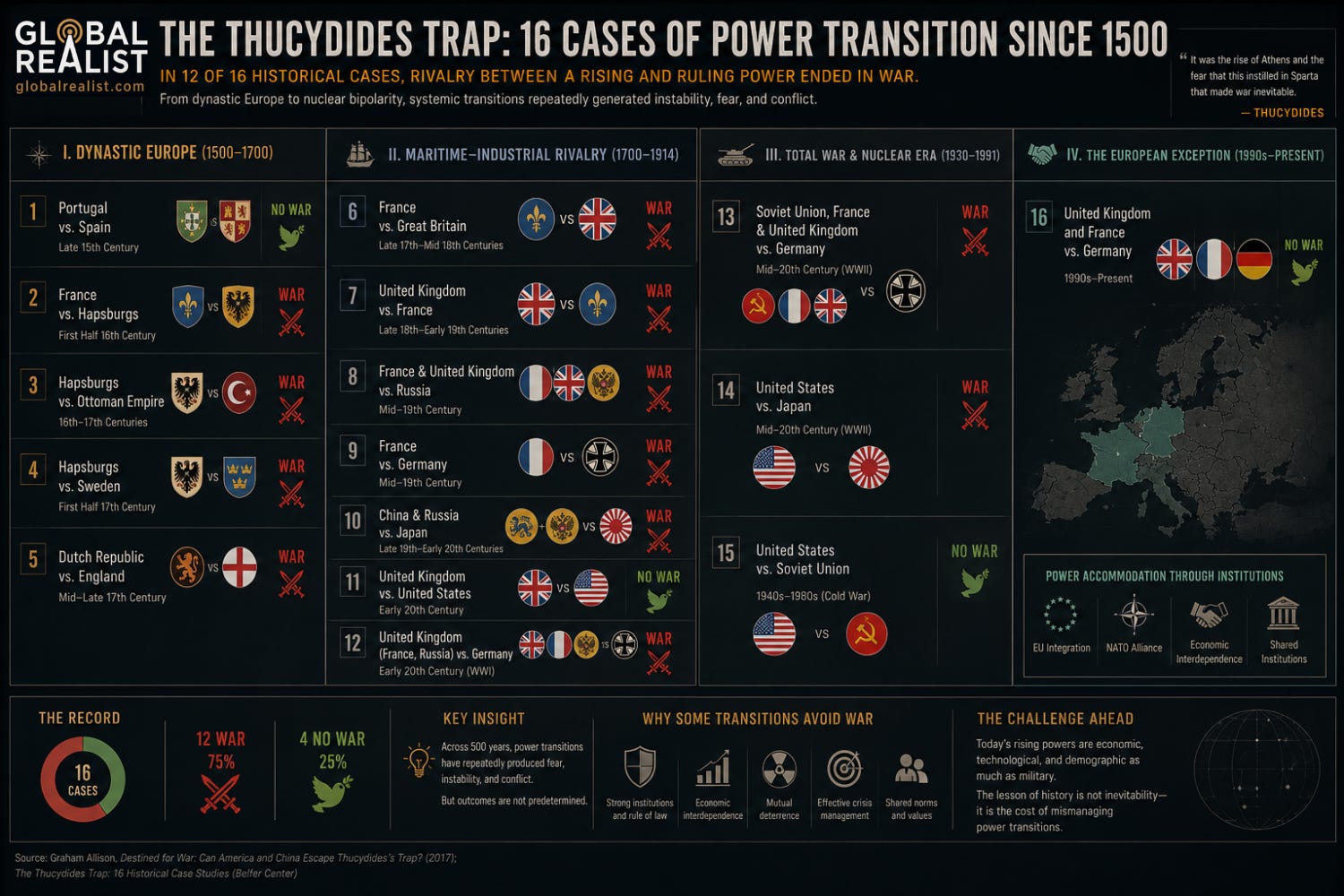
The doctrine is also an instrument. When invoked by a rising power, it functions as a rhetorical chokepoint. It frames the avoidance of war as the responsibility of the established power, while leaving the rising power’s accumulation unconstrained. When invoked by an established power, it functions as a justification for containment, because the historical base rate suggests that the rising power must be slowed if the war is to be averted. The same doctrine produces opposite operational implications depending on who is using it and against whom.
The realist reading of the Beijing summit therefore requires holding two propositions simultaneously. The structural pressure is real, and the historical pattern is concerning. The invocation of the doctrine by either party is a strategic move within the competition the doctrine describes, not an escape from it.
For Global Realist, the Thucydides Trap is best treated as one of the analytical lenses through which great-power competition is read, alongside the broader realist tradition the publication draws on. It is neither a prophecy of war nor a guarantee of peace. It is a description of the geometry that both Washington and Beijing now operate inside.
Further reading: Graham Allison’s original 2015 Atlantic essay on the Thucydides Trap; the Belfer Center Thucydides Trap Case File with full documentation of the sixteen historical cases; Bloomberg’s explainer on Xi’s repeated Thucydides invocations.
Great essay. The Chinese have been talking about Thucydides for quite some time. Trump renews the question. The problem is that the Chinese are actually quite bleak about their own prospects. At first they were eager for an economic ascension to Thucydides. However, America has a structural advantage. They can continue to replace labour shortfalls, particularly at the top of the talent pyramid, from international sources. The second Thucydides was technological. Unfortunately, Americas advantage in energy gives it a natural advantage in the AI race- an advantage which can only be thrown away through political mismanagement and unwarranted climate catastrophism.
I was watching Doomberg interviewed by Peter Boghossian this morning. Smart questions. Even smarter answers. I'm definitely going to have to read Ray Kurzweil’s The Singularity is Near.
Of course, a lot of this is conditional. China may find a way out of the middle income per capita zone and the 421 problem. They're actually really strong on innovation, although probably lag a bit behind on efficient capitalisation to monetise. The 421 problem is the big problem. It's a problem shared by much of the developed world. Robots will probably ease the problem. A key metric people should be paying far more attention to is robots per 10,000 workers.