

Managed Rivalry: The Beijing Summit and the Architecture of Civilizational Competition
Two civilizational powers stabilize the operating system of long-duration confrontation

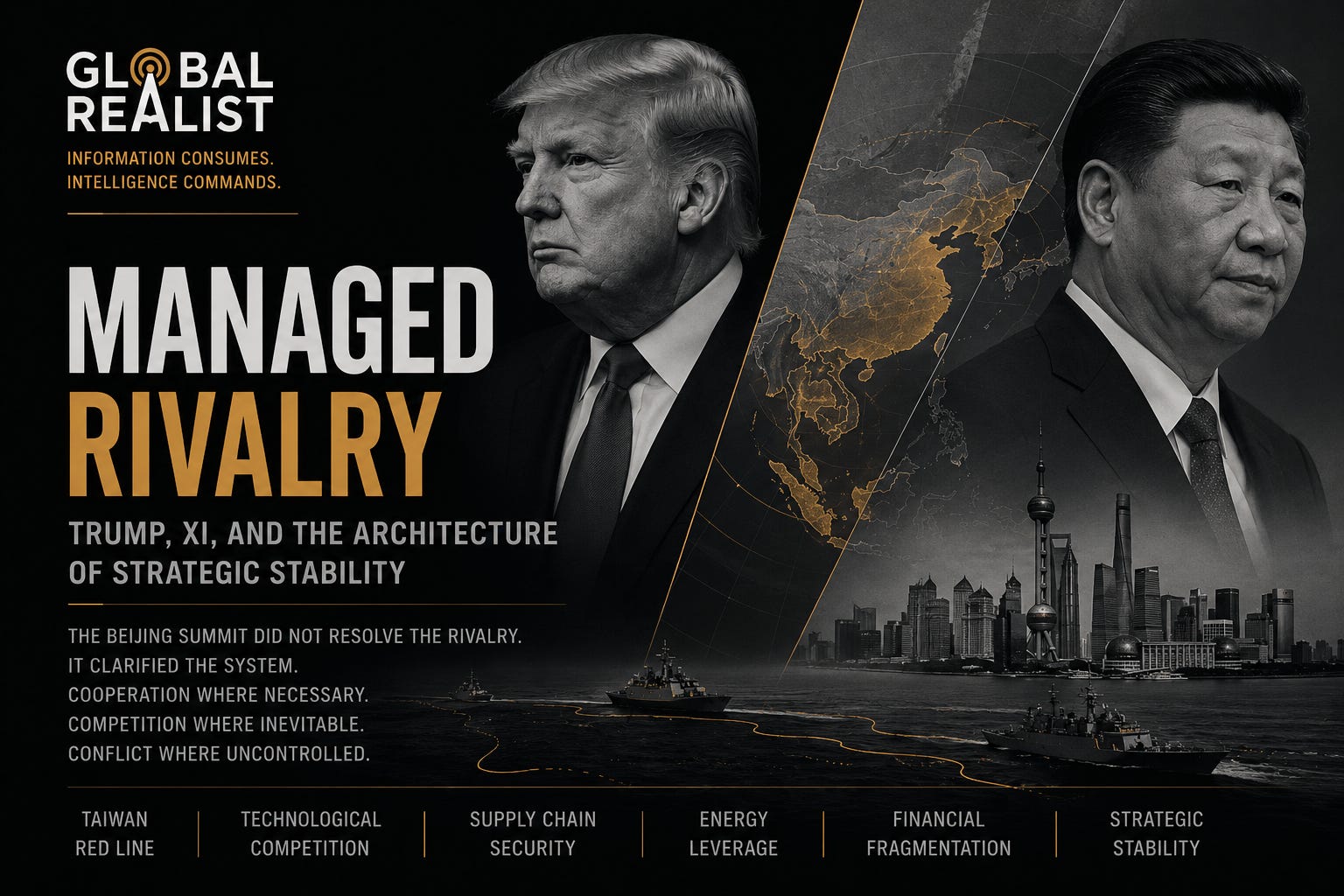
The Choreography in Beijing
On the morning of May 14, 2026, an honor guard formed in front of the Great Hall of the People. Three hundred children waved American and Chinese flags. Xi Jinping descended the steps to greet Donald Trump, then walked his delegation through a state welcome calibrated to convey continuity and weight. By midday, the two leaders had agreed to anchor the bilateral relationship in what the Chinese readout called a “constructive, strategic, stable relationship” — a three-year framework that both governments would treat as the new operating reference for the most consequential dyad in the international system. By the banquet that evening, Trump had extended Xi an invitation to Washington in September.
The composition of the American delegation was its own structural signal. Marco Rubio carried the diplomatic file. Pete Hegseth sat across from Dong Jun. The commercial party included Tim Cook, Elon Musk, Jensen Huang, Larry Fink, and Kelly Ortberg — Apple, Tesla, Nvidia, BlackRock, Boeing. The lineup represented the sectors through which American power either consolidates or hemorrhages over the next decade: advanced semiconductors, electric mobility and orbital launch, AI compute, the capital-allocation layer, and large-aircraft export. Each executive in the room belongs to a chokepoint in the bilateral dependency knot. Their physical presence in Beijing communicated a reality that the formal communiqué could only paraphrase.
What the choreography did not produce was resolution. The summit clarified the architecture of the contest. It did not close it. Within hours of the warm gestures at the Temple of Heaven, Xi delivered a remark intended for the Western press and for his own apparatus alike: Taiwan was the most important issue in the relationship, and mishandled, it would push the relationship into a place where collision or conflict could not be ruled out. The warmth and the warning were not contradictions. They were the two faces of the operating system the summit was convened to stabilize.
This is what managed rivalry looks like at the civilizational scale. The Beijing summit was not a reset, a peace conference, or a return to the integration logic of the prior cycle. It was a maintenance protocol applied to a competition that both parties now treat as structural and prolonged.
The Operating System Is Neither Globalization nor Cold War
The dominant interpretive frames available to Western commentary remain calibrated to the cycle that ended in the mid-2020s. One framework treats every U.S.-China interaction as a referendum on whether globalization can be restored. The other treats every interaction as a slide toward a second Cold War organized around ideological blocs. Both frameworks misread the geometry now in operation.
Globalization was a system of deep interdependence under American security primacy. Its premise was that economic integration would soften strategic rivalry and that universal institutions would govern the residual frictions. That system has been retired by the parties that built it. The United States has imposed a tariff architecture on Chinese imports that, even after the Busan reductions of October 2025, leaves cumulative duties at roughly 47 percent. The Department of Commerce has continued to expand the entity list, tighten end-use controls on advanced semiconductors, and harden the design-tool perimeter around Synopsys and Cadence. China has weaponized its rare-earth export licensing regime, demonstrated supply-chain coercion across magnets and processed minerals, and accelerated the Big Fund III recapitalization of domestic semiconductor capacity. Each move is incompatible with the assumptions that organized the prior cycle.
The Cold War analogy fails on the other side of the same problem. The U.S.-Soviet rivalry was a contest between two economically segregated systems. Trade between the blocs was marginal; supply chains did not cross the divide; the strategic competition ran on parallel and largely sealed industrial bases. The current configuration is structurally different. The American AI stack depends on Taiwanese fabrication that, in turn, depends on Dutch lithography, Japanese chemistry, and a Chinese consumer market for trailing-node output. The Chinese industrial base depends on American design IP, allied capital equipment, and continuous access to the dollar-denominated trade and settlement system. The two systems are not segregated. They are entangled at the load-bearing layer of advanced production, and the entanglement itself has become a deterrent.
What the summit confirmed is that the operating system in formation is neither the integration of the 1990s nor the segregation of the 1980s. It is something the prior analytical vocabulary does not name well. Selective disentanglement at the strategic margins. Preserved interdependence at the productive core. Hardened deterrence across the maritime perimeter. Continuous bargaining over the rate at which each variable is allowed to move. The relationship now operates as a dual track: confrontation in technology, industrial policy, and Taiwan; coordinated stabilization across trade settlement, energy flow, and diplomatic management of third-theater crises. The two tracks are not contradictory. They are the architecture.
In the framework of Existential Imperative Realism, this is the expected outcome when two civilizational-scale states confront one another under conditions of mutual hostage geometry. Each state pursues its survival imperatives — industrial capacity, technological sovereignty, territorial control, energy access, mythos. Neither can afford an uncontrolled rupture. Both face internal pressure to demonstrate that the rupture is being prevented while the structural competition continues. Managed rivalry is the operating mode that emerges when full decoupling is too costly to execute and full integration has become incompatible with both habitus.
Keep reading with a 7-day free trial
Subscribe to Global Realist to keep reading this post and get 7 days of free access to the full post archives.